
The semiconductor industry has run the same basic playbook for sixty years. Photolithography — the process of etching circuit patterns onto chips using light — has been refined to extraordinary precision, but its fundamental architecture hasn’t changed. What has changed is the physics: silicon-based chips are approaching their physical limits, and the performance gains that once came automatically from shrinking transistors are slowing to a crawl.
Photonic chips offer a compelling path forward. By transmitting data using photons rather than electrons, they deliver dramatically higher speeds at a fraction of the energy cost — a combination that matters enormously for AI inference, data center cooling, and the next generation of computing infrastructure. The bottleneck has never been the idea. It’s been manufacturing: photonic chips are technically complex and expensive to produce at scale, and the tooling to make them efficiently simply hasn’t existed.
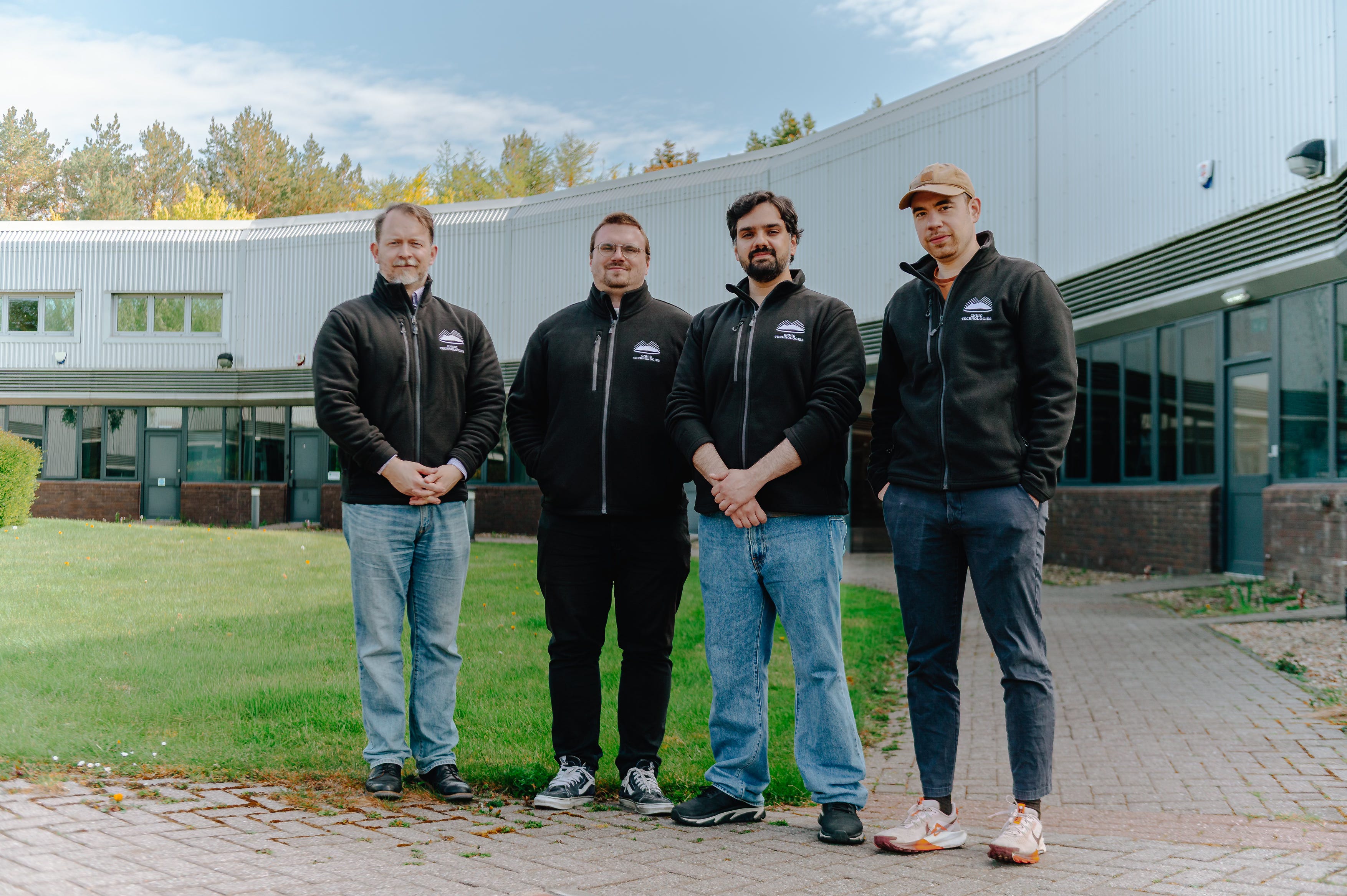
Cnuic, an Edinburgh-based 🏴 deep tech company, has built that tooling.
The company has developed a working prototype of an entirely new type of photolithography device — one that exploits the wave properties of light to enable rapid, reconfigurable production of photonic chips with enhanced 3D control. This is not an incremental improvement on existing methods. It is a fundamentally different approach to patterning chips, making possible what was previously impossible: flexible, high-precision manufacturing of photonic structures that legacy equipment cannot produce.
Cnuic has raised $3M in a pre-seed round led by Tensor Ventures and Blank Space Ventures, with participation from Silicon Roundabout Ventures, Phasechange, SANDS, and Superlative. The round was oversubscribed — a signal of how seriously the deep tech investment community is taking both the technology and the team behind it.
Why This Matters Now
The AI infrastructure buildout has made the economics of photonic chips newly urgent. Data centers running large-scale model training consume staggering amounts of power — much of it lost to heat generated by electron-based communication between processors. Photonic interconnects eliminate that bottleneck. For the hyperscalers investing hundreds of billions in AI compute, the savings from switching to photonic infrastructure at scale are not marginal. They are structural.
But the promise of photonic chips has long outpaced the ability to manufacture them cost-effectively. Cnuic’s technology directly addresses that gap — and does so with a platform that is inherently reconfigurable, meaning it can serve not just photonic chips but a broader range of light-based applications: metalenses, 3D photonic crystals, AR and VR waveguides, and beyond.
As co-founder Omar Durrani puts it: “Every major leap in human capability has come from learning to use a new medium better. We learned to use electrons. Now we are learning to use light. Cnuic is building the tools that make that possible at scale.”
Our Perspective
Tensor Ventures has conviction in deep tech companies that address structural constraints in industries approaching inflection points. The semiconductor industry is at one of those inflection points now — and the manufacturing layer is where the leverage sits.
What drew us to Cnuic is the nature of the breakthrough itself. This is not a software layer on top of existing hardware, or a process optimization within the current paradigm. It is a new category of manufacturing tool, protected by novel intellectual property, developed by a team with deep roots in photonics research.
As Ondřej Lipold, partner at Tensor Ventures, notes: “Cnuic’s technology can democratize the production of photonic chips in much the same way that PCs democratized computing power.” Martin Drdúl, co-founder of Tensor Ventures, who oversaw the investment alongside Ondřej, adds: “From a deep tech perspective, this is a completely new technology and a major breakthrough that could mean a whole new role for Europe in the semiconductor industry.”
Scotland has quietly built one of Europe’s strongest photonics research ecosystems, centered on Edinburgh and Glasgow. Cnuic is a product of that ecosystem — and potentially its most consequential commercial expression yet.