
Manufacturing has an invisible tax. It shows up not in the cost of raw materials or energy, but in the hours lost every time a machine stops and no one immediately knows why. By most estimates, up to 80% of unplanned downtime is spent diagnosing a fault — not fixing it. The wrench is ready. The technician is not.
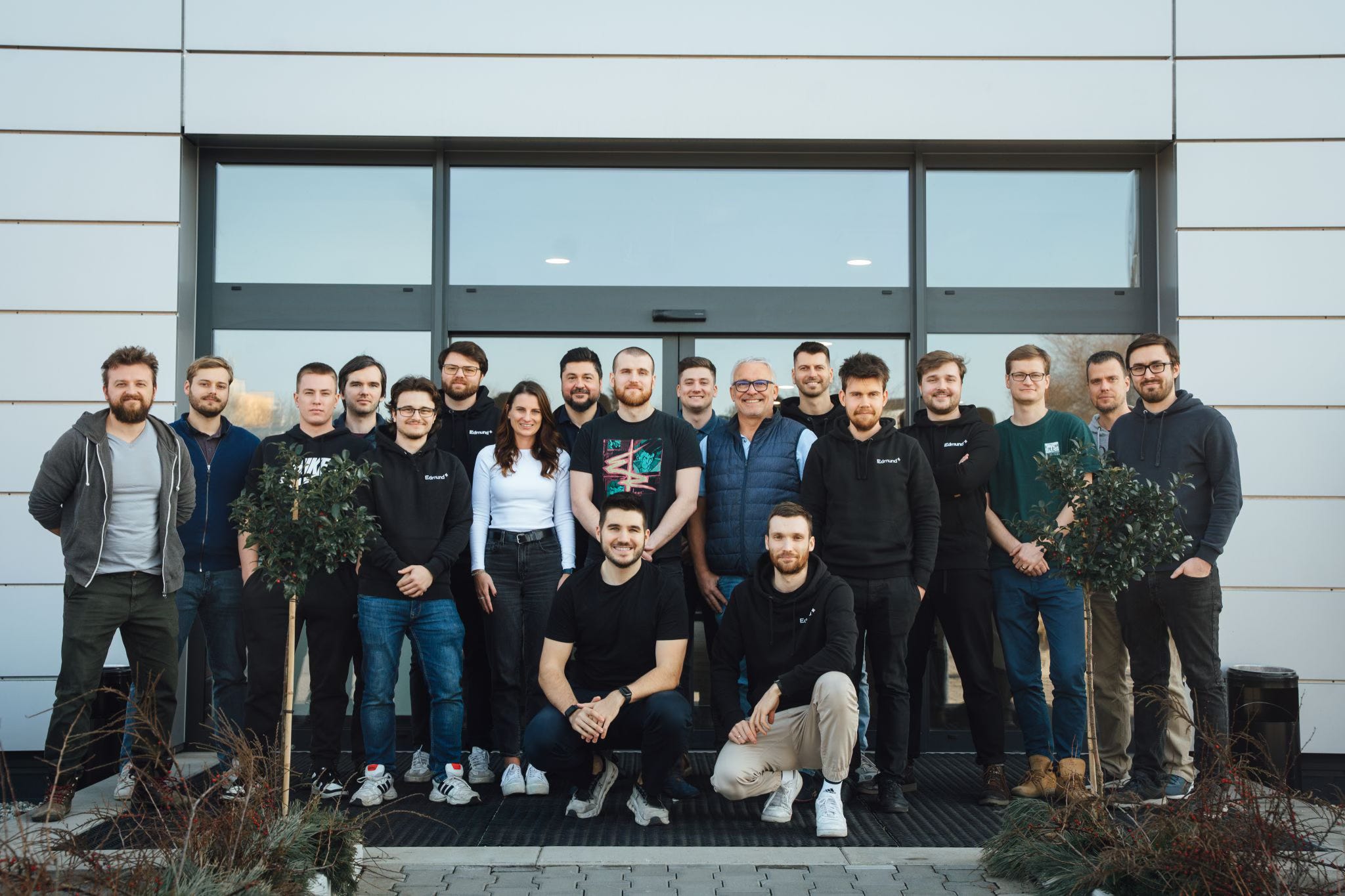
Edmund, an industrial AI company founded in Ostrava in 2023 by Jakub Szlaur, Benjamin Przeczek, and Miroslav Marek, has built a platform to close that gap. The company has just closed a €2.5 million Seed round led by FORWARD.one, with participation from University2Ventures and Tensor Ventures.
The Problem Is Context, Not Data
Modern factories are rich in data and poor in understanding. PLC programs govern how machines behave, service records capture what went wrong before, and technical documentation describes how systems are architected — but none of these speak to each other. When something fails, a skilled engineer must mentally stitch these sources together under pressure, often while production is stopped. That synthesis is the bottleneck.
Edmund’s platform acts as a reasoning layer across all of it. It ingests PLC projects, electrical schematics, maintenance histories, and real-time machine data, and builds a contextualised model of each specific machine. When a fault occurs, technicians can identify its root cause in minutes rather than hours. In controlled deployments, the platform has reduced the diagnostic phase by up to 90% — with one customer, Amcor Flexibles, reporting faster repairs of over 25% and an annual saving of approximately 440 hours of skilled labor.
As Szlaur puts it: “The real challenge isn’t a lack of data — it’s a lack of context. We’re building AI agents that understand how machines actually work, down to the level of the control program.”
Why Now, Why CEE
The urgency is structural. European manufacturing faces a compounding talent problem: tens of thousands of maintenance positions sit unfilled, and roughly one in five current workers is expected to retire within the decade. The knowledge these engineers carry — accumulated over careers spent learning specific machines in specific plants — cannot be easily transferred. Edmund’s thesis is that this expertise can be captured, structured, and made accessible to the next generation of workers before it walks out the door.
Central and Eastern Europe, where Edmund has built its initial commercial base, is an ideal starting point for this kind of product. The region houses some of Europe’s most sophisticated manufacturing operations in automotive, food processing, and heavy industry — sectors where margins are tight, machine complexity is high, and the cost of downtime is acute. CEE is not a fallback geography; it is a proving ground for industrial depth.
Our Perspective
At Tensor Ventures, we back deep tech companies addressing structural problems in industries that have long operated below their technical potential. Industrial maintenance sits squarely in that category. The gap between what modern AI can do and what actually reaches the factory floor is still enormous — not because the technology is unavailable, but because translating machine intelligence into operational context is genuinely hard. Edmund has done that translation work.
What distinguishes the team is their grounding in the specifics of industrial control systems. Building an AI that reasons over PLC logic is not a generative AI wrapper problem — it requires understanding the engineering domain deeply enough to model how failures propagate through real systems. That domain depth, combined with early commercial traction and a clear expansion path into Western Europe and the US, is why we participated in this round.
We’re pleased to be backing Jakub, Benjamin, and Miroslav as they build toward what they describe as a standard technology layer between machine and human in manufacturing — not another chatbot, but infrastructure for how industrial work actually gets done.